
I had never heard of Cardiff’s Tiger Bay before reading this book but after reading it, I feel like somehow after a year at home, I’ve been there.
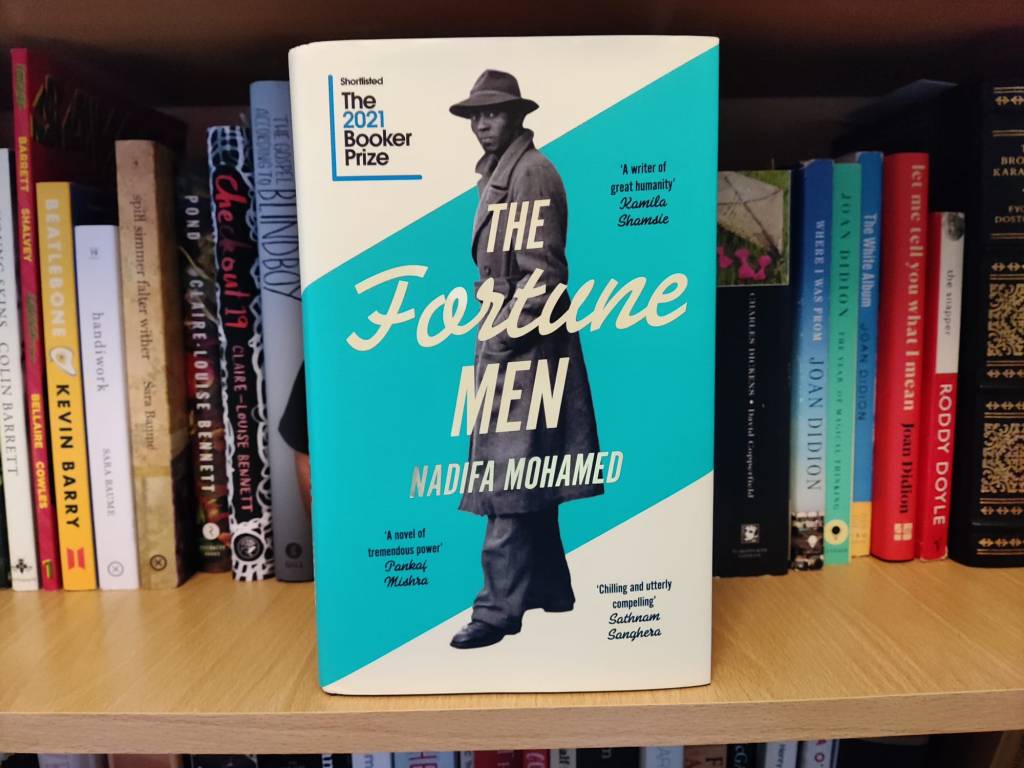
The Fortune Men by Nadifa Mohamed tells the real-life story of Somali immigrant Mahmood Mattan. Mahmood is a unique fixture in Cardiff’s Tiger Bay and is nicknamed the “shadow” for the quiet and stealthy way he moves around the town. When we first meet him, Mahmood is separated from his wife Laura and their three young sons. He is living in boarding houses and spending his days betting on horses and playing poker. He is in and out of jail for shoplifting and other pretty crimes, but the reader is never given the impression that he is a serious criminal. Mahmood doesn’t seem to consider himself to be a criminal either and at one point even pays back some money he had stolen when times were tight. Mahmood is deeply disenfranchised with his lot in life and as he relates his experience working in ships and living as a black man in the UK it is apparent as to why he feels and acts the way he does.
This book does a fantastic job of painting a detailed picture of post-war Tiger Bay and the people who live there. Tiger Bay is wonderfully diverse with Arab and African sailors coming in through the port and Jewish shopkeepers running their family businesses. The community is still recovering from the war – families still mourn for those they lost and shelled houses still lie in ruin in parts of the city. Diana, one of the other narrators, talks about a night of bombings in Tiger Bay during World War II. The next morning while the dust was still falling and fires burned around the city, she walks out onto the street and see’s someone has chalked “There will always be a Tiger Bay” onto the pavement. This is a community that will not be beaten down, that is finding a way to survive and coexist in post-war Britain.
This novel skips between narrators and even narrative style. This is something I don’t always enjoy but I had no issue with and even felt added to the tension of certain scenes. Even though the narrator shifts, Mahmood is the main focus – this is his story. And Mahmood is such an interesting character. He has travelled all over the world as a sailor and learned to speak five languages. Nadifa Mohamed does a really good job of getting across his multilingualism. When he is conversing with his friends in Somali or Arabic, the dialogue is related in perfect English. But when he speaks in English it is heavily accented.
The start of the novel seems to be building towards something, and indeed circumstances change once a local shopkeeper is murdered and some cash stolen. Mahmood, a known criminal to the police, is immediately suspected of the crime. What follows is the reason his story is still being written about.
Most reviews of this novel talk about the ending, but I don’t want to do that. I had not read any reviews or Googled ‘Mahmood Mattan’ before I sat down and read this novel. But I knew what was going to happen, I knew how it was going to end and I suspect that you do too. A black man is accused of murdering a white woman in 1952 Brittan. How else can this story end? And that’s what bothers me, how little the world has changed since then that we can all see what is coming. The institutional and systemic racism in this novel is still familiar over 50 years later.
This book is powerful. Mahmood is a unique and endearing character. I found myself really starting to care for him as the novel progressed though there were moments when I wanted to shake him for his naivete and pride. Yet, you cannot blame him for either attribute and as things go from bad to worse for him you understand why he does what he does. Nadifa Mohamed does an incredible job of bringing him to life for us.
I really enjoyed this book and would recommend that everyone read it. As for whether or not it will win the Booker, I think it has a good chance. This book explores current social issues but reminds us that they have always been there and highlights the absurdity of the fact that society is still plagued by them. Nadifa Mohamed’s The Fortune Men should be required reading.
 Meghan Helms